Case study / 02
SiloSense
Mines Git history to show where knowledge is concentrated in too few developers — before someone leaves.
- Category
- Software
- Role
- Final year project · B.Sc. Software Engineering
- Year
- 2026
- Status
- Live
Overview
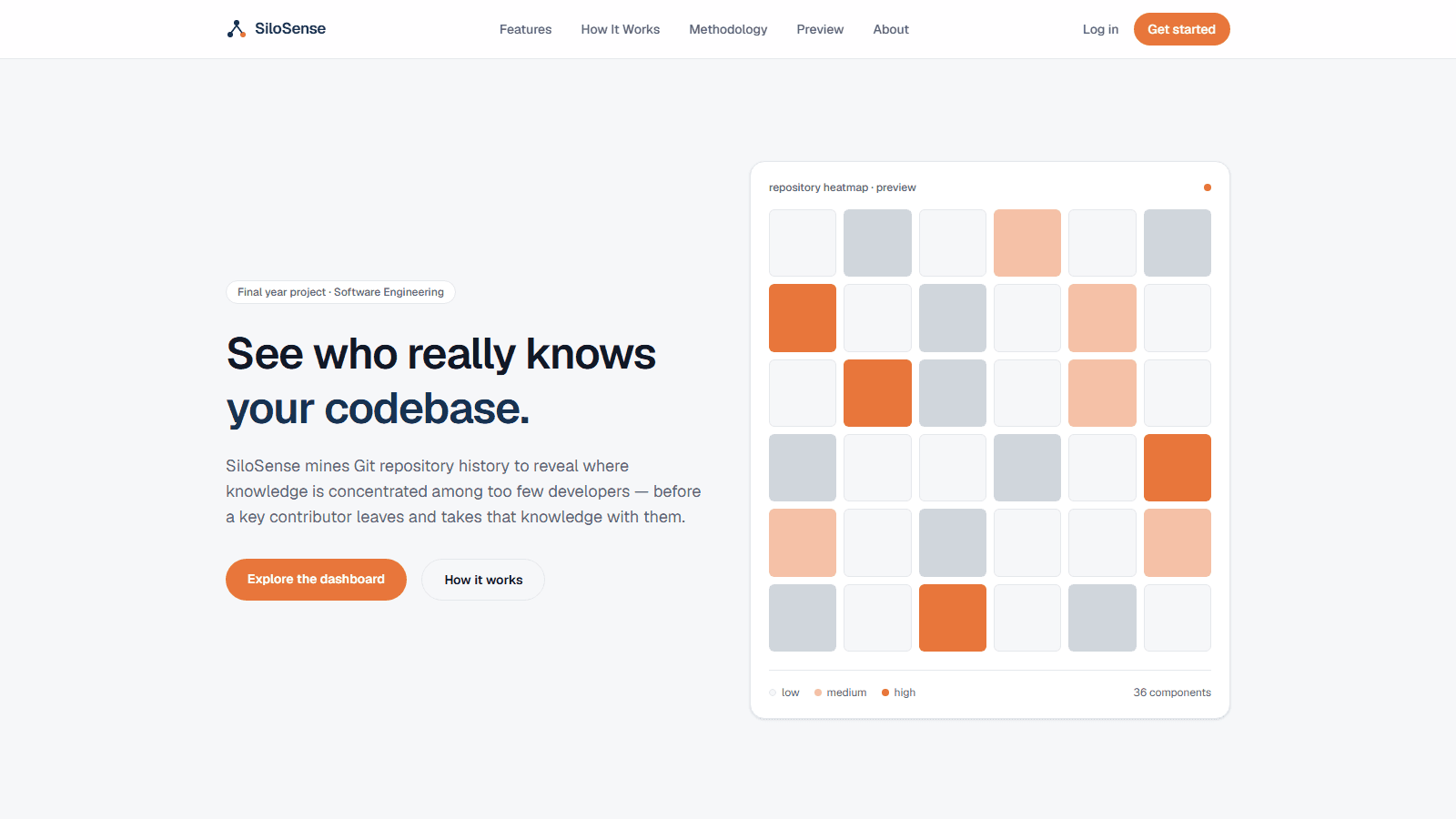
SiloSense is my final year project in Software Engineering at Bayero University Kano. It mines a repository's commit, blame and pull-request history to find components where knowledge is concentrated among too few developers, scores each one from 0 to 100, and shows the results as an interactive heatmap, with alerts and pairing recommendations to spread ownership.
The problem
Every codebase has files only one person really understands. Teams usually find out when that person goes on leave or resigns — the so-called truck factor. Existing tools show who committed what, but not where that concentration has become a risk.
Approach
- Repository mining: extract commit, blame and pull-request metadata through the GitHub and GitLab APIs.
- Component-level risk score: Risk = 100 × (w₁·C + w₂·R + w₃·X), combining contributor concentration (C), recency of the main contributors (R) and complexity (X), each normalised to [0, 1].
- Weights are tuned during evaluation rather than fixed, so the model can be recalibrated per project; an optional lightweight ML model refines the baseline score.
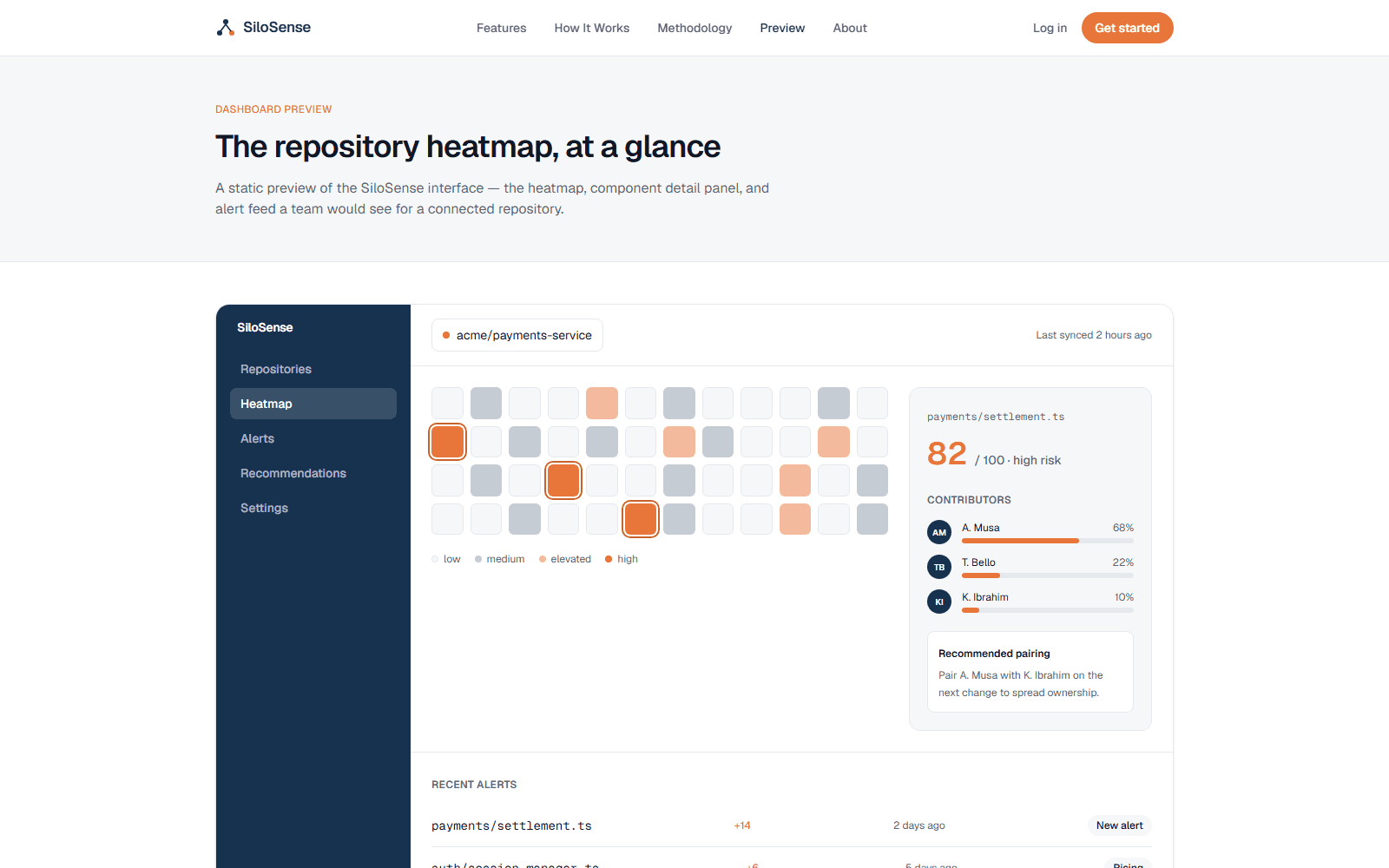
- Interactive heatmap with drill-down to the files and contributors behind each score.
- Historical tracking with threshold alerts, plus pairing recommendations that suggest who should work together to reduce single-owner risk.
Screens
Outcomes
- Evaluated on real open-source repositories (5–10 projects), comparing flagged components against documented contributor departures rather than synthetic data.
Stack
GitHub / GitLab APIsGit miningRisk scoringMachine learningData visualisationRender